
BY OLAPEJU OLUBI
The Director General of the Ghana Civil Aviation Authority (GCAA), Rev. Stephen Wilfred Arthur, has declared that the Aero Contractors Aircraft Maintenance Organisation (AMO) in Lagos is strategically positioned to service commercial aircraft operating across West and Central Africa, describing the facility as a major cost-saving asset for airlines in the region.
He made the remarks after a guided tour of the Aero maintenance facility located at the airline’s head office within the General Aviation Terminal (GAT), Murtala Muhammed International Airport, Lagos. The visit exposed him to the hangars, equipment, tooling, and technical manpower deployed at the facility, leaving him visibly impressed.
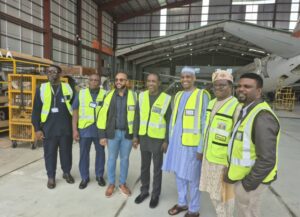
“This is unique by all standards. And I least expected to see what we have all witnessed today, especially from this part of the continent,” the GCAA boss said and noted that the facility compares favourably with similar operations outside Africa.
He linked the persistent high cost of air tickets in the sub-region to aircraft maintenance expenses, explaining that the routine practice of ferrying aircraft to Europe or the United States for heavy checks significantly drives up airline operating costs.
“Many of us out there have no idea how the cost of aircraft maintenance affects the overall cost of operation, which eventually translates to the cost of an air ticket. This is because it is not just the fuel that is used to fly, but the cost of maintaining, repairing and overhauling the aircraft,” Arthur added.
According to him, the absence of major Maintenance, Repair and Overhaul (MRO) facilities within close proximity forces airlines to incur huge expenses, which are ultimately transferred to passengers.
“If such a facility is not readily available within a certain geographical precinct, it adds more to the cost of the airline’s operations and business. And which eventually will be translated to the paying passenger,” he added.
The GCAA Director General stressed that having a functional MRO within the region drastically cuts costs by eliminating long-haul ferry flights and reducing ancillary expenses such as crew allowances, fuel for extended flights, and navigation charges.
He also pointed out that proximity shortens maintenance turnaround time, allowing aircraft to return to service faster and generate more revenue for operators.
“And so, we as Ghana and other neighbouring states, especially in the ECOWAS region, I believe that it is a great blessing to have this facility being operated, owned and managed by Aero Contractors. It is really good news to celebrate and to promote,” he said.
The Ghana CAA DG, who confirmed that his country is currently in the process of establishing a national carrier, said the presence of a capable maintenance facility within Nigeria provides reassurance and operational confidence for emerging airlines in the sub-region.
“I think that we should celebrate the existence of Aero MRO and encourage airlines to patronise it. Because it is in patronising it that they can also expand and offer more. And in our local parlance, we say that if you cannot beat them, you join them. So, Ghana will join our big brother in Nigeria, taking a very bold lead in using its services,” he said.
He emphasised that the Aero MRO is not a national asset for Nigeria alone but a strategic facility for the entire aviation industry in West and Central Africa.
“It is not just something for Nigeria. It is not just for the sub-region but it is for the aviation industry as a whole that we have such a facility here in our neighbourhood. And so, it is a cause to celebrate, to patronise and to see expansion,” Arthur said.
The GCAA boss also disclosed that Nigeria was the first country he visited following the confirmation of his appointment, underscoring the importance Ghana places on regional aviation collaboration.
In his opening remarks, the Managing Director and Chief Executive Officer of Aero Contractors Limited, Captain Ado Sanusi, welcomed the GCAA Director General and provided a historical overview of the airline’s evolution.
He said Aero Contractors, established in 1959, began operations with oil and gas shuttle services before expanding into scheduled commercial flights and aircraft maintenance.
“We operated helicopters and then later we started operating fixed wings and we became very, very dominant in oil and gas and then we ventured into airline business,” Captain Sanusi said.
He noted that Aero Contractors pioneered major aircraft maintenance in the region, adding: “We are the first again to perform C-check on Boeing 737 Classic in West and Central Africa and since then we have been operating our maintenance facility, providing services to airlines within West Africa and beyond.”
According to him, the company has secured maintenance approvals from several West African countries and is pushing further to meet global regulatory standards.
“Now we have approvals on a number of West African countries and beyond. Our intention is to get EASA (European Union Safety Agency) approval and FAA (US Federal Aviation Administration) approval for line maintenance and go to even base maintenance,” Sanusi said.
He also revealed plans to resume flight operations to Accra in the near future, reinforcing Aero Contractors’ commitment to deepening regional connectivity and cooperation.
With growing airline traffic and renewed interest in regional aviation, industry stakeholders say the expansion and patronage of indigenous MROs like Aero’s could mark a turning point in reducing operating costs and strengthening Africa’s aviation value chain.

Olapeju is a journalist and aviation reporter.