
BY OLAPEJU OLUBI
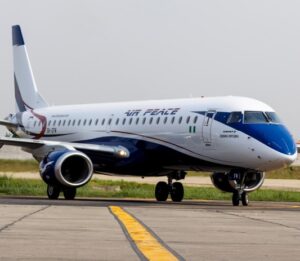
Air Peace has vehemently refuted allegations by SaharaReporters that it deceived Nigerians over the proposed Lagos–São Paulo direct flight, describing the report as malicious, misleading and part of a coordinated smear campaign against the airline and the Federal Government.
In a detailed response, the airline dismissed claims that it collaborated with the Tinubu administration to mislead the public, insisting that no fraud, deception, or false promise was ever made regarding the South American route.
According to Air Peace, the report relies on unnamed and unverifiable sources who alleged that the entire Lagos–São Paulo arrangement was “deceptive from the outset.”
The airline countered that nothing could be further from the truth, stressing that aviation operations—especially long-haul international routes—require multiple regulatory, technical, and commercial approvals before flights can commence.
The airline clarified that what was previously announced between Nigeria and Brazil was a Memorandum of Understanding (MoU), not a confirmed flight launch.
An MoU, it explained, is a diplomatic framework that signals intent to deepen bilateral aviation cooperation; it does not amount to ticket sales, confirmed flight schedules, or an operational guarantee.
“In aviation practice, several mandatory processes must be completed after an MoU before any flight can take off,” Air Peace stated, adding that presenting the agreement as a commercial launch misrepresents standard global aviation procedures.
The airline also rejected claims that Nigerians were “stranded” or left in limbo by the unlaunched route. Air Peace maintained that no tickets were sold, no booking platforms were opened, and no official flight date was ever announced.
“It is therefore illogical to claim that passengers were stranded by a flight that was never placed on sale,” the airline noted. “What exists here is self-imposed expectation, not deception.”
Air Peace further emphasized that international long-haul operations cannot be rushed or influenced by political goodwill or media attention. It listed a series of regulatory and operational requirements that must be satisfied before launching the Lagos–São Paulo service.
These include the implementation of Bilateral Air Services Agreement (BASA) frameworks, approvals from Brazil’s civil aviation authority (ANAC), slot allocations at São Paulo airports, safety and insurance certifications, Extended-range Twin-engine Operational Performance Standards (ETOPS) clearance, aircraft deployment planning, and detailed route economic assessments.
On fleet capacity, Air Peace confirmed that it has the necessary aircraft to operate the route. The airline currently operates four Boeing 777-200/300 wide-body aircraft.
Two are assigned to its London Heathrow and London Gatwick services, while the remaining two are on standby for other long-haul destinations—including São Paulo—once all regulatory and commercial approvals are secured.
“Until these requirements are fully met, no responsible airline would announce ticket sales or commence operations,” Air Peace stated.
The airline also rejected insinuations that it made binding commercial commitments or promised a fixed launch date.
It explained that statements of intent or optimism should not be misinterpreted as guarantees, noting that airlines often study and prepare new international routes over extended periods.
By way of example, Air Peace revealed that its London operations took approximately seven years from initial conception to actual execution, underscoring the complexity and long-term planning required for long-haul route development.
Addressing public concerns over the high cost of international connecting flights, Air Peace argued that it cannot be blamed for global airfare structures or foreign airline pricing policies.
It stressed that the existence of an MoU does not automatically translate into reduced ticket prices or immediate fare relief for travelers.
In a stronger tone, the airline described the SaharaReporters publication as an act of “deliberate blackmail” allegedly sponsored by vested interests seeking to undermine both Air Peace and the Nigerian government.
“For the avoidance of doubt, Air Peace remains the only airline in Nigeria and the West African sub-region with the capacity to undertake transoceanic flight operations using its own wide-body fleet,” the statement said, suggesting that this competitive edge may be fueling sustained attacks on the airline’s reputation.
Air Peace further disclosed that preparations for the Lagos–São Paulo route began as early as last year.
The airline has been engaging relevant Nigerian authorities, collaborating with the Brazilian government, and working with key stakeholders in Brazil to ensure the successful rollout of the service.
However, it reiterated that all regulatory, technical, and commercial processes must be fully concluded before any official announcement or ticket sales can occur.
“Aviation is not a cut-and-paste business,” the airline warned. “The safety of passengers, crew, and equipment remains a sine qua non.”
The airline condemned what it described as attempts by individuals or groups to undermine a Nigerian business through misinformation and media manipulation in the hope of gaining a competitive advantage.
Air Peace also criticized SaharaReporters for what it called a recurring pattern of distortions, including turning diplomatic engagements into alleged fraud, branding patience and due process as
“stranding,” replacing verifiable facts with anonymous emotion, and ignoring aviation realities to manufacture public outrage.
“This approach is not journalism; it is agitational storytelling,” the airline asserted.
In summarizing its position, Air Peace made four key points clear: no flight tickets were sold, no Nigerian was abandoned, no scam took place, and an MoU should not be confused with a boarding pass.
The airline reaffirmed its commitment to transparency, professionalism, and regulatory compliance, promising that the Lagos–São Paulo route will be formally announced only when all conditions are fully satisfied—just as it has done with every other destination in its network.
Until then, Air Peace urged Nigerians to rely on verified facts rather than fear-driven narratives or sensational headlines, insisting that responsible aviation development must be guided by safety, due process, and operational readiness—not media pressure.

Olapeju is a journalist and aviation reporter.