
BY OLAPEJU OLUBI
The Nigerian Aviation Handling Company Plc (NAHCO Aviance) has highlighted its commitment to enhancing non-oil revenue by supporting Nigeria’s Small and Medium Enterprises (SMEs) in accessing global markets.
The company made this commitment during a capacity-building forum on export processing for SMEs held in Lagos on Tuesday, organised in collaboration with the Nigerian Association of Chambers of Commerce, Industry, Mines and Agriculture (NACCIMA).
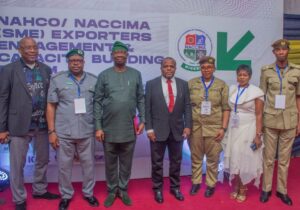
The event focused on equipping SMEs with practical knowledge, operational tools and strategic insights to navigate international trade, while emphasising the critical role of air logistics in boosting export volumes. It brought together key stakeholders from government, finance, logistics, and industry to discuss pathways for expanding Nigeria’s non-oil export base.
Prince Saheed Lasisi, Group Executive Director, Business & Business Development at NAHCO, explained that the initiative aligns with the Federal Government’s vision of achieving a $1 trillion economy by 2030.
“A major focus of the government in achieving this goal is commodity exports. And to record the needed volume in commodity exports, the nation needs the small and medium enterprises (SMEs),” he said.
He added that NAHCO recognises the strategic contributions of SMEs to national development and is actively supporting their readiness for international markets.
“Exporting agro-products and commodities requires a strong logistics and handling backbone, and NAHCO sits at the centre of the export value chain. We serve as the link between exporters, airlines, and regulators,” Lasisi said.
He further explained that NAHCO offers guidance on crucial aspects of cargo handling, including product preservation, regulatory compliance, timely flight connections, and meeting the standards of international buyers.
He also highlighted the specialized packaging required for sensitive and perishable goods.
“With the approval of the Federal Airports Authority of Nigeria (FAAN), we established the NAHCO Export Packaging and Processing Centre (NEPPC)—the first and only facility of its kind in Nigeria—which began operations in July last year. NAHCO also has an Export Desk that offers dedicated support to exporters,” Lasisi said.
Kola Awe, Chairman of the NACCIMA Export Group, outlined the hurdles that SMEs often face in scaling their businesses abroad.
“We have created the NACCIMA Export Support Centre for MSMEs. Many exporters encounter multiple challenges that hinder growth. Multinationals manage these issues more easily due to their financial strength, but MSMEs often struggle. Our support centre is a practical solution to help SMEs navigate the complexities of exporting,” he said.
Awe also highlighted the economic significance of SMEs. “MSMEs contribute enormously to Nigeria’s economy. There are an estimated 39.6 million MSMEs in the country, though this number has slightly declined in recent years due to a challenging economic climate. These enterprises are heavily represented in agriculture, retail, and manufacturing. Providing targeted support is essential to unlock their export potential.”
Engineer Sola Obadimu, Director-General of NACCIMA, said the collaboration between NAHCO and NACCIMA illustrates the importance of private sector partnerships in growing Nigeria’s agro-products exports.
“MSMEs account for 80 to 90% of businesses and employ over 80% of the workforce, yet their contribution to exports is disproportionately low. Encouraging more SMEs to embrace exporting can change this. Overcoming barriers requires cooperation among various stakeholders,” he stated.
Obadimu noted that although agriculture contributes over 20% of Nigeria’s GDP, agro-based exports still make up only a modest portion of national export earnings. Procedural bottlenecks, limited export knowledge, low export readiness, logistical challenges, and restricted access to structured support were cited as factors limiting SMEs’ international reach.
Mrs. Ladi Ene Garba, Head of Commercial Banking at Polaris Bank, emphasized the strategic need to diversify Nigeria’s economy. “This program is especially timely as Nigeria seeks to reduce dependence on crude oil, which currently accounts for roughly 90% of our foreign exchange earnings. Non-oil exports contribute less than 10% of economic output. Expanding this sector is therefore not optional—it is a strategic imperative,” she said.
Garba also highlighted the vulnerabilities of Nigeria’s fiscal structure. “Our reliance on crude oil exposes the economy to external shocks and global oil price volatility. A strong non-oil export sector will deliver multiple benefits across the economy. Polaris Bank, as a leading supporter of SMEs, will continue providing the financial backing needed to empower these businesses to compete globally,” she added.
Mr. Ikechi Uko, President of the Aviation Cargo Committee, stressed the role of air logistics in enabling SMEs to scale.
“Air freight is crucial for the growth of SMEs. Many aircraft arrive in Nigeria fully loaded but leave empty. The government is working to organize the air export sector so that planes depart carrying Nigerian goods,” he said.
Dr. Akin Oladipupo, MD/CEO of Burcont Shipping Nigeria Limited, commended the collaborative effort.
“I want to thank NACCIMA and NAHCO for hosting this forum and for bringing stakeholders together to discuss the industry. There are billions of naira tied up in Nigeria’s agricultural and farming sectors that remain untapped. What is Nigeria doing to increase food exports? Forums like this help identify solutions,” he said.
The event was attended by key government agencies critical to agro exports, including the Nigeria Customs Service (NCS), Nigerian Agricultural Quarantine Service (NAQS), National Agency for Food and Drug Administration and Control (NAFDAC), National Drug Law Enforcement Agency (NDLEA), Nigerian Export Promotion Council (NEPC), Federal Produce Inspection Office (FPIS), Federal Competition & Consumer Protection Commission (FCCPC), and the Federal Airports Authority of Nigeria (FAAN).
Airlines and logistics partners were also present, including Turkish Cargo, Lufthansa, Qatar Airways, Kenya Airways, RwandAir, DHL, Burcont Logistics, and NAGAFF, highlighting the multi-stakeholder approach necessary for successful export expansion.
Participants discussed the full export value chain, from packaging, handling, and regulatory compliance to financing, documentation, and market access.
They noted that integrating SMEs into global supply chains requires both technical knowledge and operational support, as well as strategic partnerships across private and public sectors.
Prince Lasisi added, “NAHCO is not just a facilitator of exports; we are a strategic partner for SMEs. From ensuring cargo quality to connecting exporters with airlines and regulators, we are at the heart of Nigeria’s export value chain. Our goal is to prepare SMEs to compete in international markets, reduce export losses, and increase the country’s non-oil revenue.”
The forum underscored the role of collaborations like NAHCO and NACCIMA in diversifying Nigeria’s economy.
By providing SMEs with knowledge, technical support, and access to air logistics, the initiative seeks to expand the country’s non-oil export base while empowering businesses to compete globally.
As Nigeria works to reduce its overreliance on crude oil, stakeholders say that forums such as this demonstrate the potential of private sector partnerships to transform the country’s export landscape.
With SMEs forming the backbone of the economy, targeted interventions and strategic collaborations could unlock new revenue streams, boost foreign exchange earnings, and contribute significantly to the government’s $1 trillion economy vision for 2030.

Olapeju is a journalist and aviation reporter.