

BY OLAPEJU OLUBI
Nigeria’s aviation modernisation push gathered fresh momentum on Thursday, as the Federal Government broke ground for a new Corporate Headquarters and Air Traffic Management (ATM) Centre for the Nigerian Airspace Management Agency (NAMA) in Abuja.
This was disclosed by the Director, Public Affairs and Consumer Protection, Dr Abdullahi Musa in a statement.
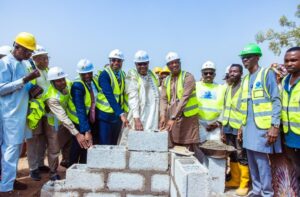
The ceremony, held at the Nnamdi Azikiwe International Airport, was led by the Minister of Aviation and Aerospace Development, Festus Keyamo, who described the project as a strategic leap toward consolidating Nigeria’s airspace control under one technologically advanced hub.
He said the new complex is “a declaration of intent and a tangible demonstration of our unwavering commitment to modernizing the critical infrastructure that underpins the safety, efficiency, and growth of Nigerian aviation.”
According to the minister, the headquarters will merge NAMA’s executive management functions with a cutting-edge ATM Centre, eliminating structural fragmentation and enhancing coordination.
“For too long, our agencies have operated in silos and in structures that do not reflect their national significance. With this new headquarters, we are creating a conducive environment that fosters innovation, enhances collaboration, and boosts the morale of the dedicated professionals who work tirelessly to keep our airspace safe,” Keyamo stated.
He stressed that the project followed a transparent procurement process in line with the Public Procurement Act 2007, assuring stakeholders that timelines and technical specifications would be strictly enforced.
“We will hold the contractor to the highest standards of quality and timelines as stipulated in the agreement as there would be no compromise on specifications or delivery benchmarks,” he added.
In his address, NAMA’s Managing Director, Engr. Ahmed Umar Farouk, described the day as one that would be “etched in gold in the annals of the agency’s history.”
He noted that since its creation in 1999, NAMA operated its administrative headquarters from Lagos for over two decades before commencing relocation to Abuja in 2020 in compliance with federal policy. For six years, staff have functioned from temporary facilities in the capital.
“For the past six years, our staff have operated from temporary facilities in Abuja, yet they have continued to deliver safe, efficient, and reliable air navigation services. Today, we take the definitive step to provide them with the world-class facility they deserve,” Farouk said.
At the heart of the project is a unified Air Traffic Management Centre that will collapse the existing Area Control Centres in Lagos and Kano into a single operational command in Abuja, creating what he called a “cohesive One Flight Information Region (FIR) for Nigeria.”
“From this very spot, NAMA will exercise consolidated oversight of Nigeria’s airspace, ensuring that every aircraft, from take-off to landing, is guided by a single, harmonized operational authority.
“A unified radar view reduces coordination risks during sector handovers and enhances overall situational awareness,” he explained.
Farouk disclosed that the ATM system will deploy advanced automation and scalable infrastructure designed to handle future growth in traffic volumes.
The system, he said, will optimise routes, cut fuel burn for airlines, improve efficiency and reduce long-term operational costs.
The complex will also house 15 to 16 departments, a 200-seat conference hall, a library, registry and executive suites.
Staff welfare facilities will include rest areas for air traffic controllers, recreational spaces, a drivers’ lounge and a daycare centre.
Supporting infrastructure such as a dedicated water treatment plant, standby power systems, enhanced security posts and ample parking will also form part of the design.
While celebrating the milestone, the NAMA chief appealed for sustained funding support, particularly for the agency’s proposed Dual Surveillance System intended to serve both civil aviation and military command-and-control operations.
“This is not merely a technological upgrade. It is a strategic investment in securing our sovereign airspace and strengthening coordination between civil aviation authorities and national defence institutions”, the NAMA boss said.
With construction underway, stakeholders believe the project signals a new chapter in Nigeria’s aviation story, one defined by centralised control, modern infrastructure and strengthened national airspace security.

Olapeju is a journalist and aviation reporter.