
BY OLAPEJU OLUBI
Nigeria has taken a historic leap onto the global aviation stage with the launch of the first-ever Nigeria International Airshow, signaling the nation’s ambition to join the ranks of countries hosting world-class aviation showcases.
The event, hosted under the Ministry of Aviation & Aerospace Development, brings together industry leaders, global investors, regulators, and aviation enthusiasts to explore opportunities, display cutting-edge technology, and celebrate the country’s rapidly evolving aviation sector.
In a foreword for the Airshow’s inaugural magazine, the Minister of Aviation & Aerospace Development welcomed guests with a message of pride, optimism, and determination.
He described the event as a defining moment for Nigeria, a bold step toward claiming its place among the world’s aviation powerhouses. “For decades, the question has been asked: When will Nigeria take its rightful place in the global aviation showcase circuit? Today, with this inaugural Airshow, we provide a clear and confident answer,” the Minister said.
Acknowledging that the Airshow is just the beginning, the Minister emphasized that this first edition is a foundation for growth. “It will not be perfect.
We are taking baby steps, but we are taking them with courage, conviction, and clarity of purpose,” he noted, underscoring the commitment to refine and expand the event in future years until it stands shoulder to shoulder with Paris, Dubai, Farnborough, and Singapore.
The Airshow, Keyamo stated, reflects the vision of President Bola Tinubu for a modern, safe, secure, and globally competitive aviation sector that drives economic growth, strengthens national security, supports tourism, and positions Nigeria as Africa’s aviation hub.
Under the Renewed Hope Agenda, aviation has emerged as one of the fastest-growing sectors in the country, achieving transformative milestones that have reshaped Nigeria’s regional influence and global standing.
The Minister highlighted significant achievements across multiple facets of the sector.
Nigeria has attained and maintained world-class safety rankings through rigorous oversight by the Nigerian Civil Aviation Authority, while major airports have been upgraded and recertified to meet international standards.
Advanced safety equipment, including approach lighting systems, Instrument Landing Systems, and enhanced surveillance technologies, has been deployed to safeguard passengers and aircraft alike.
Airport infrastructure has been modernized with expanded terminals to improve passenger experience, rehabilitated runways to strengthen operational capacity, and upgraded cargo and logistics facilities to enhance Nigeria’s competitiveness in regional trade.
Legal and regulatory reforms, particularly the implementation of the Cape Town Convention and the Aircraft Protocol, have boosted aircraft financing and leasing, enabling swift and transparent deregistration and repossession of aircraft while increasing investor confidence and reducing risk perceptions.
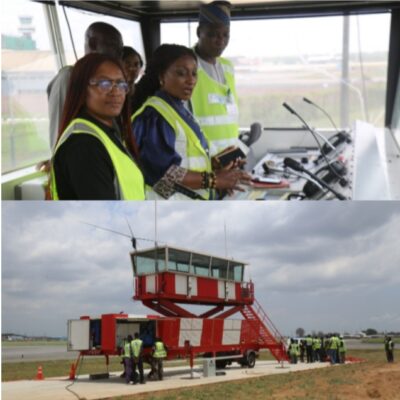
Nigeria’s airspace has undergone significant modernization, with advanced communication, navigation, and surveillance systems installed through the Nigerian Airspace Management Agency, radar coverage upgraded, and air traffic management processes digitized.
Performance-based navigation procedures are now operational nationwide, enhancing safety and efficiency.
At airports managed by the Federal Airports Authority of Nigeria, security architecture has been strengthened, service quality measures improved, and operational reforms are ongoing to meet global standards.
The government has also supported aircraft leasing and fleet renewal, engaging global manufacturers and financiers to modernize the national airline fleet while fostering private sector participation through airport concessions, public-private partnerships, cargo terminal upgrades, and aviation city developments.
Internationally, Nigeria has expanded bilateral air service agreements, strengthened leadership roles in ICAO and AFCAC, and deepened participation in global aviation programs, reflecting its growing influence in African and global aviation.
Capacity-building initiatives have been a central focus, with expanded training programs at the Nigerian College of Aviation Technology, upgraded simulators, and enhanced opportunities for pilots, engineers, and air traffic controllers, ensuring a steady pipeline of skilled professionals ready to support a modern aviation industry.
The Airshow itself is more than an exhibition; it is a platform for discovery, innovation, and investment. Global manufacturers, investors, regulators, and aviation enthusiasts converge to showcase technology, exchange ideas, and explore partnerships.
For young Nigerians, it offers a glimpse into the possibilities within aerospace engineering, aviation technology, drones, defense systems, and the limitless opportunities the sector presents.
The Minister called for patience, collaboration, and ambition as the event matures. “It may not be perfect, but it is our beginning. With each edition, we will refine, expand, and elevate this Airshow until it becomes a global benchmark,” he said.
He congratulated the organizers, aviation agencies, industry stakeholders, partners, and the Nigerian aviation community for making this historic moment possible, emphasizing that the Airshow is a step toward greatness and a symbol of national ambition.
Standing at the heart of the maiden Nigeria International Airshow, the nation takes flight toward a future where it is not only Africa’s aviation hub but a global player shaping the next generation of flight.
Today, Nigeria signals to the world that it is ready to lead, innovate, and compete, setting the stage for a new era in African aviation.

Olapeju is a journalist and aviation reporter.