


LookBY OLAPEJU OLUBI
The Nigerian Meteorological Agency (NiMet) has urged greater collaboration with the private sector and development partners to enhance weather observation systems, improve climate services and protect lives and livelihoods in the face of growing climate risks.
Delivering the address for the World Meteorological Day 2026 celebration, Professor Charles Anosike, Director-General/Chief Executive Officer of NiMet and Nigeria’s Permanent Representative to the World Meteorological Organisation (WMO), said the event offered an opportunity to celebrate scientific achievements in meteorology while reflecting on the role of weather and climate services in sustainable development.
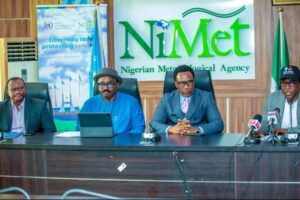
The theme for this year, “Observing Today, Protecting Tomorrow,” underscores the importance of accurate and timely observations as the foundation for reliable forecasts, early warnings, and climate planning.
“Every forecast, every early warning, and every climate outlook begins with accurate, timely, and reliable observations collected from land, water, air, and space,” Prof. Anosike said.
Highlighting NiMet’s achievements, he noted the agency’s ongoing efforts to expand and modernise Nigeria’s meteorological infrastructure, including surface and upper-air observation networks, satellite data reception systems, and automatic weather stations.
These systems support aviation safety, agricultural planning, disaster preparedness, maritime safety, and informed economic decision-making.
Anosike also pointed to NiMet’s international engagement, providing peer advisory services to Liberia, Niger, Somalia, and Burkina Faso under the WMO’s Systematic Observations Financing Facility (SOFF), strengthening observational capacity in Least Developed Countries.
Despite progress, the DG warned that climate change and increasing extreme weather events are stretching meteorological services.
“Governments, communities, businesses, and livelihoods now rely more than ever on timely and accurate weather information to protect lives, safeguard infrastructure, and sustain economic activities,” he said.
He emphasised the critical role of the private sector in expanding observation capabilities and innovation.
“Private companies investing in weather stations, remote sensing, AI models, and observation technologies complement national networks. Public-private collaboration is essential to a robust and sustainable meteorological system,” Prof. Anosike said.
Citing the State of the Climate in Nigeria 2025 report, he highlighted record daytime temperatures above 40°C in 23 cities, with Nguru, Yobe State, experiencing 100 days above 40°C, alongside increasing flood events nationwide—data made possible through quality observation systems.
He concluded by urging industry leaders, innovators, financial institutions, and development partners to partner with NiMet: “Observing Today, Protecting Tomorrow is not just a theme; it is a call to action. Every observation collected today safeguards our future and strengthens our resilience against climate risks.”

Olapeju is a journalist and aviation reporter.