

BY OLAPEJU OLUBI
The Federal Government’s plan to reposition the Nigerian Safety Investigation Bureau as an independent multimodal accident investigation body received strong institutional backing in Abuja on Thursday, as key stakeholders across aviation, maritime, rail, road transport and security sectors endorsed the new presidential framework.
The high-level engagement, held at the Joint Intelligence Board Hall of the Office of the National Security Adviser, brought together top officials from transport regulators, emergency response agencies, security institutions and economic management bodies to align on implementation of the reform approved by President Bola Ahmed Tinubu in March 2026.
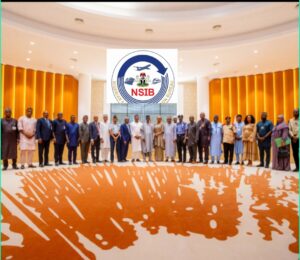
Under the new structure, NSIB will now report directly to the Presidency through ONSA, a shift away from its previous supervisory link with the Federal Ministry of Aviation and Aerospace Development.
The session was chaired by National Security Adviser, Mallam Nuhu Ribadu, with Special Adviser to the President on Policy and Coordination, Hadiza Bala Usman, serving as co-chair.
Also present were representatives of major agencies including the NCAA, FAAN, NAMA, NPA, NIWA, NRC, FRSC, NEMA, NPF, FERMA, CBN, OAGF, NNPC Ltd., the Armed Forces and other key institutions.
Stakeholders described the reform as a timely response to the growing complexity of transport-related incidents, many of which now overlap with security threats, infrastructure vulnerabilities and emergency response gaps.
They agreed that a unified investigative framework would strengthen coordination, improve data sharing and enhance national readiness during major incidents.
Speaking at the meeting, NSIB Director-General, Captain Alex Badeh Jr., said the new arrangement would deepen transparency and operational independence.
“Our responsibility remains preventive, not punitive. The Bureau determines probable causes of accidents, identifies systemic safety gaps, and issues recommendations aimed at preventing future occurrences. We do not regulate, prosecute, or apportion blame,” Badeh said.
He explained that the reform would improve response timelines, strengthen evidence preservation and enhance coordination during multi-agency investigations, particularly in complex cases involving overlapping jurisdictions.
Badeh also noted that past investigations had been hampered by delays in data access and institutional overlaps, adding that the new structure would significantly reduce such operational constraints.
National Security Adviser Nuhu Ribadu said the Presidency approved the reform to remove bureaucratic bottlenecks, strengthen neutrality and build a more coordinated national safety architecture.
According to him, “the ONSA would provide institutional coordination and oversight support,” especially in cases involving systemic failures or inter-agency accountability concerns.
He added that an independent reporting line was essential to preserving public trust and investigative integrity, disclosing that steps were already underway to amend the NSIB Establishment Act 2022, with the Office of the Attorney-General expected to lead a technical drafting process.
Hadiza Bala Usman, in her remarks, said the reform aligns Nigeria’s accident investigation system with global best practices, citing models such as the United States National Transportation Safety Board, Canada’s Transportation Safety Board and France’s aviation investigation authority.
She described the restructuring as part of President Tinubu’s broader push for results-driven governance and stronger institutional coordination across sectors.
The meeting resolved that inter-agency standard operating procedures would be developed within 30 days, memoranda of understanding concluded within 60 days, and legislative amendments initiated to fully operationalise the new framework.
The session ended with unanimous stakeholder support for the reform and renewed commitments to deepen cooperation through structured coordination, shared protocols and joint operational frameworks.
The overhaul marks a significant shift in Nigeria’s transport safety architecture, positioning accident investigation not only as a technical function, but as a core pillar of national resilience, accountability and emergency preparedness.

Olapeju is a journalist and aviation reporter.