


BY OLAPEJU OLUBI
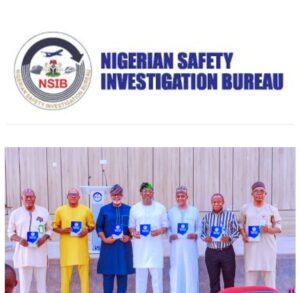
Nigeria’s accident investigation architecture is being fundamentally reset, as the Nigerian Safety Investigation Bureau (NSIB) rolls out new Conditions of Service (CoS) that prioritises independence, performance and the well-being of its workforce.
This pans away from legacy civil service traditions.
Backed by approval from the Office of the Head of the Civil Service of the Federation, the new framework arrives at a key moment.
Following its repositioning under the incumbent administration, the NSIB now reports directly to the Presidency, an institutional upgrade designed to insulate investigations from bureaucratic bottlenecks and enhance operational credibility.
For an agency tasked with probing accidents across aviation, marine, rail and road transport, that autonomy is critical. It elevates the NSIB into a truly multimodal, independent safety authority, capable of conducting rigorous, transparent inquiries that meet global standards.
The CoS itself is being framed as a “collective covenant,” one that aligns Nigeria’s administrative practices with international benchmarks while embedding a culture of accountability, productivity, and continuous learning.
A major pillar of the reform is the replacement of the outdated Annual Performance Evaluation Report (APER) system with a modern Performance Management System (PMS).
Under the new regime, staff performance is measured against clearly defined Key Performance Indicators (KPIs), tracked in real time throughout the year.
The shift introduces consequences and incentives. Performance outcomes are now directly linked to promotions, rewards, and sanctions, fostering a merit-driven environment in an agency where precision, objectivity, and technical competence are non-negotiable.
But perhaps the most groundbreaking element of the reform is its recognition of the human cost of accident investigation.
Investigators often work in distressing environments, examining wreckage, analysing fatalities, and operating under intense pressure. For the first time in Nigeria’s public sector, the NSIB has formally embedded Trauma Risk Management into its workforce policy.
This includes structured psychological support and designated “mental day off” provisions, ensuring that personnel exposed to traumatic events can recover adequately and maintain peak cognitive performance.
“This milestone represents a transformative commitment to elevating our organisation’s foundation,” said Captain Alex Badeh Jr., Director General and CEO of the NSIB.
“It sets forth essential policies and standards governing employment, career advancement, and ethical conduct, ensuring equity while fostering an environment where productivity thrives, accountability is resolute, and institutional excellence becomes the norm.
It is my fervent aspiration that these Conditions of Service will propel the Bureau forward, empowering our team to execute their vital roles with unparalleled professionalism, passion, and resolve.”
The reforms also place strong emphasis on human capital development.
The CoS guarantees access to specialised training, professional certifications, and institutional backing for memberships in elite global bodies such as the Council for the Regulation of Engineering in Nigeria (COREN) and the International Federation of Airline Pilots’ Associations (IFALPA).
By doing so, the Bureau is positioning its investigators to operate seamlessly alongside counterparts in leading agencies like the United States’ National Transportation Safety Board (NTSB) and the United Kingdom’s Air Accidents Investigation Branch (AAIB).
Beyond technical capacity, the welfare package extends to comprehensive healthcare for staff and their families, childcare support through a crèche for nursing mothers, and recreational facilities aimed at strengthening workplace cohesion and morale.
The wider message is that Nigeria is not only reforming an agency but redefining how safety oversight is conceived and delivered.
A well-resourced, psychologically supported, and professionally trained investigative body enhances trust in transport systems, reduces systemic risks, and ultimately protects lives and economic assets.

Olapeju is a journalist and aviation reporter.