
BY OLAPEJU OLUBI
Minister of Aviation and Aerospace Development, Festus Keyamo, has called for urgent and practical steps to unlock Africa’s aviation potential, insisting that the continent must move beyond policy declarations and focus on reforms that deliver real benefits to airlines and passengers.
Keyamo made the call at the African Air Transport Expo 2026 held in Lomé, Republic of Togo, where he participated in two high-level panel discussions on the implementation of the Single African Air Transport Market (SAATM) and air transport affordability.
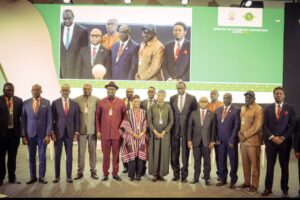
His remarks come on the heels of the African Development Bank’s (AfDB) proposed $7 billion funding support for Africa’s Aviation Transformation Programme, a move expected to accelerate the development of the continent’s air transport sector.
Speaking during a session on market access and the implementation of SAATM, Keyamo stressed that African countries must move beyond signing agreements and begin taking concrete actions to facilitate unrestricted air connectivity across the continent.
“We must move from signatures to actual traffic rights. Over the next 24 months, Nigeria will streamline permits for African carriers, align air agreements, and lead the Banjul Accord Group (BAG) to progressively treat West Africa as a unified domestic market,” he declared.
The minister said enhanced market access remains a critical requirement for achieving the African Union’s vision of a fully connected continent.
According to him, seamless air transport connectivity would stimulate trade, tourism, investment flows and regional integration across Africa.
Industry analysts have long argued that despite several agreements aimed at liberalising African airspace, many countries still maintain restrictive policies that limit access for airlines from other African nations.
These restrictions have been blamed for high ticket fares, poor connectivity and the continued dominance of foreign carriers on several African routes.
Keyamo noted that implementing SAATM effectively would help dismantle such barriers and create a more competitive aviation environment capable of driving economic growth.
On the issue of affordability, the minister reiterated Nigeria’s commitment to reducing the financial burden on both airlines and passengers.
He described aviation as a strategic economic enabler that should support national development rather than serve primarily as a source of government revenue.
“Aviation is an economic enabler, not a revenue collection point. Nigeria is aggressively driving down costs through a 30% discount on statutory fees for domestic operators approved by Mr. President, transitioning toward VAT neutrality, and auditing duplicate levies,” he stated.
The minister explained that reducing operational costs for airlines would ultimately translate into lower fares for travellers, increased passenger traffic and stronger airline profitability.
He also challenged governments, regulators and aviation stakeholders across the continent to focus on measurable outcomes rather than issuing declarations that produce little practical impact.
“The real test of our success is no longer how many declarations we adopt, but how many African routes we open, how many restrictions we remove, and how many passengers actually benefit,” Keyamo said.
His intervention received widespread support from participants at the conference, many of whom viewed Nigeria’s commitments as a significant contribution towards accelerating the implementation of SAATM and advancing aviation liberalisation across Africa.
The African Air Transport Expo brought together aviation ministers, regulators, airline executives, airport operators, development finance institutions and industry stakeholders from across the continent to deliberate on strategies for transforming Africa’s aviation sector into a catalyst for economic growth.
Stakeholders at the event agreed that improving connectivity, lowering operational costs and expanding market access remain essential to unlocking the vast economic opportunities offered by Africa’s aviation industry.
With the AfDB’s proposed $7 billion aviation transformation initiative and renewed commitments from leading aviation nations such as Nigeria, industry observers believe the continent may be entering a new phase in its quest for a more integrated, competitive and affordable air transport ecosystem.

Olapeju is a journalist and aviation reporter.