
…Says Move Endangers Safety
BY OLAPEJU OLUBI
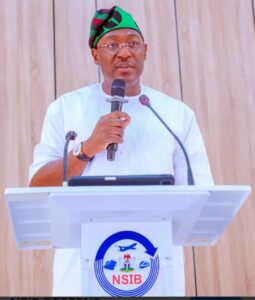
The Director-General of the Nigerian Safety Investigation Bureau (NSIB), Captain Alex Badeh Jr, has warned that a proposed reduction in the Bureau’s share of the Ticket Sales Charge (TSC) could undermine accident investigations and aviation safety in Nigeria.
Badeh, who spoke virtually with aviation correspondents on Friday, strongly opposed a bill before the National Assembly seeking to reduce the NSIB’s allocation from the TSC from six per cent to four per cent.
He said safety remained the ultimate priority in aviation and warned that any policy capable of weakening the country’s accident investigation system should be resisted.
“If you think safety is expensive, wait for an accident. We are all in this sector and we know that such proposal is going to affect the NSIB negatively; it is not a workable solution to any issue,” he said.
The proposed amendment has triggered renewed disagreement among aviation agencies over the sharing formula for the five per cent TSC and Cargo Sales Charge (CSC) paid by airlines and administered by the Nigerian Civil Aviation Authority (NCAA).
The charges are currently shared among the NCAA, Nigeria Airspace Management Agency (NAMA), Nigerian Meteorological Agency (NiMet), Nigerian College of Aviation Technology (NCAT) and NSIB.
Under the existing arrangement, the NCAA receives 56 per cent of the funds, NAMA 22 per cent, NiMet nine per cent, NCAT seven per cent and NSIB six per cent.
The proposed reduction in the NSIB’s share has raised concerns within the Bureau, which argues that its responsibilities have expanded significantly, particularly following the Federal Government’s move to strengthen its multimodal safety investigation mandate.
Badeh said the NSIB’s responsibilities now extend beyond aviation to include investigations into accidents involving other modes of transportation, making sustainable funding more critical.
According to him, reducing the Bureau’s share at a time when it is expected to investigate accidents across aviation, maritime, rail and road transportation could weaken its ability to carry out its statutory responsibilities effectively.
He also raised concerns over the non-remittance of funds due to the NSIB by some agencies operating in other transport sectors.
Badeh specifically mentioned the Nigerian Maritime Administration and Safety Agency (NIMASA) and the Nigerian Railway Corporation (NRC), saying the Federal Airports Authority of Nigeria (FAAN) was the only agency that had consistently met its financial obligations to the Bureau.
He said NIMASA had argued that the relevant provision was not contained in its enabling law.
The NSIB boss called for a more sustainable funding structure, saying the Bureau had already submitted proposals to the Presidency and was hopeful that its funding position would improve under the new budget.
“We are working on a sustainable funding framework and had proposed to the Presidency and we are hoping that with the new budget, we have our own strong funding.
“We would like to say that whatever modes we are investigating, it is still Nigerians that are using these modes of transportation, therefore there must be sustainable funding for us,” he said.
The funding dispute comes amid growing scrutiny of Nigeria’s aviation safety architecture, with stakeholders divided over how revenues from charges paid by airlines should be distributed among the agencies responsible for regulating, managing and supporting the industry.
For the NSIB, however, Badeh argued that the issue goes beyond revenue sharing, insisting that adequate funding is directly connected to the country’s ability to investigate accidents promptly, identify their causes and issue safety recommendations to prevent recurrence.
He said a properly funded investigation bureau was essential to ensuring that lessons from accidents and serious incidents were identified and translated into measures that could prevent future occurrences.
Badeh also disclosed that the Bureau was preparing to fully assume its expanded multimodal investigation responsibilities but would require additional personnel and specialised expertise to do so effectively.
He said the NSIB currently had about 407 employees, which he considered inadequate for the scope of its growing responsibilities.
“We need to hire, for more requisite skills, with 407 employees, we need more personnel,” he said.
The Director-General said the Bureau already had expertise in maritime accident investigation and was strengthening its capacity through additional training and international collaboration.
“We have the expertise in maritime; we are bringing in more foreign resource persons to train with us. We are fully grounded on maritime investigation,” he said.
He also disclosed that an experienced road accident investigator would soon join the Bureau as it expands its capacity to investigate crashes involving road transportation.
The development, according to him is expected to increase pressure on the Federal Government and lawmakers to carefully examine the proposed changes to the TSC sharing formula, particularly as agencies seek adequate resources to meet their statutory responsibilities.
Badeh maintained that the central consideration should be the safety of Nigerians who rely on the country’s different transportation systems.
He argued that sustainable funding for accident investigation should not be treated as an administrative expense but as an essential component of the national safety system.
With the NSIB’s mandate expanding beyond aviation, the Bureau is seeking a funding framework capable of supporting its wider responsibilities while allowing it to recruit investigators, acquire specialised equipment, conduct timely investigations and train personnel.
The proposed cut in its TSC allocation, Badeh warned, could move the country in the opposite direction at a time when Nigeria should be strengthening its safety institutions.
For the NSIB, the debate over the TSC formula is therefore not simply about percentages, but about whether the country has the financial capacity and institutional commitment to properly investigate accidents and prevent their recurrence.

Olapeju is a journalist and aviation reporter.