


BY OLAPEJU OLUBI
In its quest to create a sound future for students, SAHCO Plc has equipped the science laboratories of Mafoluku Grammar School in Oshodi, Lagos.
This has created a strong platform for a new wave of hands-on learning, discovery and ambition among young students.
The initiative, spearheaded by the Chairman of SIFAX Group and SAHCO Plc, Dr. Taiwo Afolabi, highlights a key recognition within corporate Nigeria that meaningful nation-building must begin in the classroom, particularly in science, technology, engineering, and mathematics (STEM).
At a ceremony attended by school authorities, students, corporate executives and government representatives, Afolabi described the intervention as a “meaningful step” in a shared commitment to youth development and educational advancement.
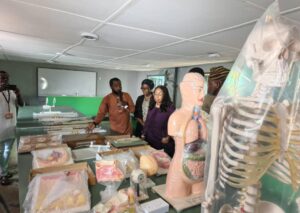
“It is a great honour to be here today as we mark another meaningful step in our shared commitment to education and youth development by equipping the Chemistry, Physics, and Biology laboratories of this great school,” he said.
Beyond the ceremonial handover, the project carries a deeper message: that education, especially science education, is central to Nigeria’s long-term economic and technological aspirations.
Afolabi emphasised that classrooms alone are no longer sufficient in preparing students for the demands of a rapidly evolving world. Instead, he argued, schools must provide practical environments where students can experiment, question, and innovate.
“Beyond classrooms and textbooks, students need access to practical learning environments where knowledge is tested, curiosity is awakened, and innovation is born. These laboratories are designed to provide exactly that,” he said.
The intervention aligns with a broader national conversation about Nigeria’s readiness to compete in a global, technology-driven economy.
According to Afolabi, the country’s ambition to become an industrial and technological powerhouse hinges significantly on how seriously it invests in STEM education, particularly at the secondary school level.
“Nigeria’s vision of becoming a technological and industrial giant rests squarely on the attention, commitment and resources devoted to the development of science, technology, engineering and mathematics in our schools,” he noted.
For the students of Mafoluku Grammar School, the newly equipped laboratories represent more than infrastructure, they symbolize opportunity.
Afolabi spoke directly to the students, urging them to embrace curiosity, resilience, and bold thinking as they engage with the new facilities.
“Within these laboratories lie opportunities for discovery. Perhaps the next great scientist, engineer, doctor, or inventor Nigeria will celebrate is seated here today,” he said. “Use them boldly. Ask questions that seem too big. Run experiments that fail, and run them again.”
The message resonated strongly with students and teachers alike, many of whom see the development as a turning point for the school’s academic trajectory.
For educators, the donation offers renewed capacity to deliver more engaging and effective science instruction.
Afolabi acknowledged their role, expressing confidence that the new resources would strengthen teaching outcomes and inspire a deeper interest in scientific inquiry.
“We appreciate your continued dedication to nurturing these young minds. We trust that these resources will enhance the teaching and learning experience,” he said.
The project also reflects SAHCO’s broader corporate social responsibility (CSR) strategy, which prioritizes education, healthcare, aviation sector development, and economic empowerment.
A company representative at the event elaborated on the motivation behind the initiative, describing it as part of a deliberate effort to invest in communities and shape future talent pipelines.
“Our chairman is deeply passionate about education and giving back. At SAHCO, our CSR pillars include education, healthcare, the aviation value chain, and economic empowerment. Education is the bedrock of any society, and we believe this is where transformation begins,” the representative said.
The choice of Mafoluku Grammar School was also strategic, reflecting the company’s focus on impacting communities within its immediate operational environment.
“We thought we should start within our environment to ensure that students have a conducive space and access to practical experience. Science is the future. Any country that does not take science seriously cannot grow or develop,” the representative added.
The initiative is not expected to be a one-off intervention. SAHCO signaled plans to deepen its engagement with the school and expand similar programs across other institutions, as part of a long-term vision to promote science education in Nigeria.
“We’ve just started. We will do more with the school. We are rolling out different programs in the educational space, and we want to catch them young and ignite their passion for science,” the representative said.
The company also highlighted its role as a major employer of science graduates in Nigeria, noting that its investment in education is closely tied to workforce development and industry sustainability.
“We are among the leading employers of science students in Nigeria, and we want to continue building that pipeline by giving young people the tools and inspiration they need early on,” the official added.
Stakeholders at the event, including school authorities and government representatives, praised the initiative as a model for public-private collaboration in education.
They noted that while government efforts remain critical, private sector involvement is increasingly essential in bridging resource gaps and driving innovation in Nigeria’s school system.
For Mafoluku Grammar School, the immediate impact is seen in better facilities, enhanced teaching capacity, and renewed student enthusiasm. But the long-term implications could be even more significant.
If sustained and replicated, such interventions could help reshape Nigeria’s educational landscape, transforming under-resourced schools into hubs of innovation and discovery.

Olapeju is a journalist and aviation reporter.